
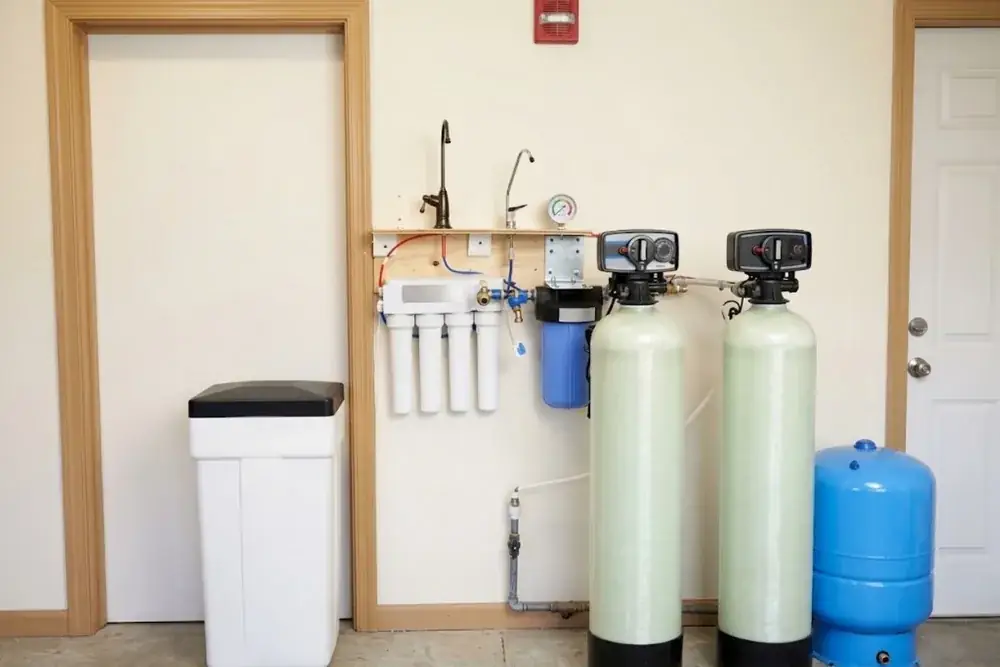
Step 1: decide whether you need one
A softener removes calcium and magnesium. Commerce City's district already treats its supply to 7 grains per gallon of hardness, which is moderate, so the benefit of a home softener is smaller than in a house on untreated hard water. If you want scale-free fixtures or protection for a tankless heater, a softener can help, and testing your water first tells you how much.
Step 2: gather what you need
- A softener sized to your household and water hardness.
- A bypass valve, either built in or added with the unit.
- Copper, PEX or flexible connectors that match your pipe.
- A drain line to a floor drain, standpipe or sink trap with an air gap.
- An overflow line from the brine tank.
- A grounded outlet within reach for the controller.
- Salt, usually pellets or blocks.
Step 3: shut off the water and cut in
Close the main water valve and open a tap to drain the line. Cut into the pipe at the chosen location and install the fittings for the inlet and outlet. If your pipe is copper, use soldered or press fittings, and if it is PEX, use crimp or expansion fittings. Keep the unit's inlet and outlet in the right order, since reversing them keeps the unit from working.
| Connection | What to check | Common error |
|---|---|---|
| Inlet and outlet | Follow the arrows on the valve | Reversing the connections |
| Bypass | Accessible and labeled | Burying it behind the unit |
| Drain line | Air gap and slope | Connecting directly to a sewer line without a gap |
| Brine overflow | Separate line to a drain | Joining it to the drain hose |
| Power | Grounded outlet | Using an extension cord |
Step 4: connect the drain
The softener drains water during regeneration, and the drain hose needs an air gap so waste cannot siphon back into the unit. Run the hose to a floor drain, a laundry standpipe or a sink trap with a proper air gap fitting. Keep the hose short and sloped, and secure it so it does not whip.
Step 5: program the controller
Set the time and the hardness. Because the district treats water to 7 grains per gallon, enter that value unless your own test shows something else. The district asks customers with in-home softeners to recalibrate to an incoming hardness of 7 grains per gallon. Set the regeneration schedule, add salt and start a manual regeneration to confirm it runs.
Step 6: test and flush
Open the main slowly with the bypass open, and check for leaks. Then switch from bypass to service and run a tap until clear. Check the drain hose during a regeneration cycle, since leaks often appear at the connections when water flows.
A short checklist before the day of the install
Walk the install location a day ahead and clear the space around the main line. Confirm there is a working outlet nearby, a floor drain or standpipe within reach, and room to lift a 40 pound bag of salt without hitting a ceiling beam.
Write down your current water pressure if you have a gauge, since a softener with a poor valve can reduce flow. Decide whether the outdoor hose spigots should stay on untreated water, which most owners prefer for lawns and car washing.
Commerce City water notes
The South Adams County Water and Sanitation District says its Ennis Water Softening Facility, operational since March 2021, treats water to 7 grains per gallon (115 milligrams per liter). Sodium will rise slightly but is not expected to exceed the EPA recommendation of 20 milligrams per liter. The district also notes that irrigation water is not softened, so do not feed the softener into irrigation lines.
Commerce City's permit list includes new plumbing fixtures and chemical dispensers connected to a water supply, and says the list is not exhaustive. A softener may or may not need a permit, so call the Building Safety Division at 303-289-3790 or email cdpermits@c3gov.com before cutting into your main.
When to hire a plumber
Cutting into the main, soldering and routing the drain are the steps where mistakes cause leaks. A plumber can complete them and set the unit. Our water softener and filtration page explains your options, and plumbing installation covers permit notes. We serve Brighton as well, where the water utility is different, so ask about your own hardness first.
What to do before work begins
What to do before you start: shut off the main, switch off the water heater power or gas so it does not run dry, and keep electrical cords out of any water. Do not solder near the bypass valve or the plastic head.
Sources and standards
Commerce City adopted the 2021 International Plumbing Code (IPC) with local amendments, and its Building Safety Division at 303-289-3790 answers permit questions. For water quality questions, the South Adams County Water and Sanitation District lists 303-287-6454 as its water quality line.
Common questions
The district asks customers with in-home softeners to set 7 grains per gallon. If you are served by another utility, ask it for its figure or test your tap.
Salt-based softening adds a small amount. The district says its own softening will not push sodium above the EPA recommendation of 20 milligrams per liter, and people on sodium-restricted diets should ask a doctor.
It is not recommended. Irrigation water is not softened by the district, and softening outdoor water wastes salt.
It depends on the project. Call the Building Safety Division at 303-289-3790 to confirm.
A plumber usually finishes in a few hours. A first-time install with new drain work takes longer.
If you prefer to skip the cutting and soldering, call the line and a Commerce City plumber can plan the installation. See our service area.
Call (303) 552-3896