
What the district already does
The district's Ennis Water Softening Facility became operational in March 2021 and treats water to 7 grains per gallon, or 115 milligrams per liter, which the district says reduces scaling and saves energy. The district asks customers with in-home softeners to recalibrate their units to an incoming hardness of 7 grains per gallon. It notes that irrigation water is not softened, so keep your softener off irrigation lines.
That means your tap water is already moderately soft. A home softener can reduce it further, but the benefit is smaller than in a house with untreated hard water, and sodium rises slightly with softening.
When a softener still makes sense
- You want scale-free fixtures, glass and shower doors.
- You have a tankless water heater and want to slow scale on its heat exchanger.
- You have an older softener that was set for harder water and needs recalibrating.
- Your home is outside the district and your own utility reports harder water.
If your home is served by another utility, such as Brighton Utilities, ask that utility for its annual water quality report. The 2024 Brighton report we reviewed did not list a hardness figure, so a home test or a call to the utility is the way to find the number.
Choosing between a softener and a filter
| System | What it addresses | Notes |
|---|---|---|
| Salt-based softener | Calcium and magnesium (hardness) | Uses salt and a drain, adds a small amount of sodium |
| Carbon whole-house filter | Chlorine taste and odor | Replace cartridges on schedule |
| Sediment filter | Sand and particles | Protects fixtures and appliances |
| Reverse osmosis at the sink | Dissolved solids, drinking water | Small tank, separate faucet |
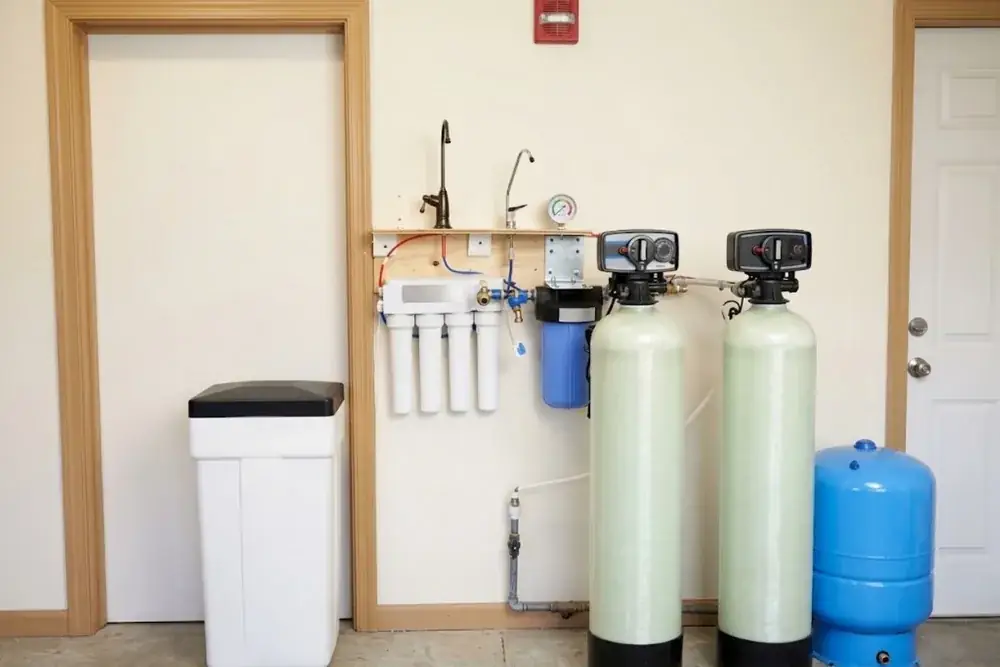
Softeners and filters solve different problems. A softener removes the minerals that cause scale, while a carbon filter removes chlorine taste and odor. The district uses chlorine to disinfect, so a carbon filter or a reverse osmosis tap addresses taste, and a softener addresses scale.
Where a softener goes and how it is installed
A softener is installed on the main water line after the shutoff and before the water heater, with a bypass valve, a drain connection and a power outlet. Outdoor spigots are usually left on unsoftened water. The installer sets the hardness value, the regeneration schedule and the salt level.
Not sure whether you need a softener, a filter or nothing. Call and describe the problem.
Call (303) 552-3896Maintenance and salt
A salt-based softener needs salt added every few weeks and an occasional cleaning of the brine tank. The resin has a lifespan of many years but loses capacity with iron or chlorine exposure. Filters need cartridge changes on a schedule that depends on use. Ask us for a service plan if you want the work done for you.
Testing your water first
Before you buy equipment, test the water. A basic hardness test strip costs little, and a lab test shows more. The district publishes an annual water quality report and has a water quality line at 303-287-6454, which is a free and reliable source of local information.
Commerce City water notes
The district says its softening project reduced scaling and created energy savings for customers, and that sodium will rise slightly but is not expected to exceed the EPA recommendation of 20 milligrams per liter. People on sodium-restricted diets should ask their doctor before adding a home softener on top of the district's treatment.
The district disinfects with chlorine and reports no lead service lines in its area. For homes with older interior plumbing, a lead test is a separate matter, and a plumber can check the pipe material at the meter and inside the house.
What shapes the price
- System type
- Softeners, carbon filters and reverse osmosis units differ in price.
- Capacity
- Larger households need larger units.
- Installation
- Plumbing, drain and electrical work vary by location.
- Ongoing
- Salt, cartridges and membranes are recurring costs.
- Existing equipment
- Recalibrating a unit costs less than replacing it.
Insurance note: water treatment equipment is not typically covered, but a leak from a tank or a brine line may be. Check the connections and the drain line after installation.
Want your real number? Call (303) 552-3896 and the price will be explained before work starts.
Sources and standards
Commerce City adopted the 2021 International Plumbing Code (IPC) with local amendments, and its Building Safety Division at 303-289-3790 answers permit questions. For water quality questions, the South Adams County Water and Sanitation District lists 303-287-6454 as its water quality line.
Common questions
The district softens to 7 grains per gallon, so many homes do not need one. A softener can still reduce scale further, and it is a personal choice.
The district asks customers with in-home softeners to recalibrate them to 7 grains per gallon. A plumber can reset the hardness value and check the unit.
No. A softener removes hardness minerals, while a filter removes chlorine, sediment or other things.
No. The district says irrigation water is not softened, and a home softener should not feed irrigation lines.
A plumber handles the bypass, the drain line, the connections and the setup. See plumbing installation for permit notes.
Call the district's water quality line at 303-287-6454, or Brighton Utilities at 303-655-2117 for Brighton customers.
The right system starts with a clear problem. Call and we will help you decide.
Call (303) 552-3896