
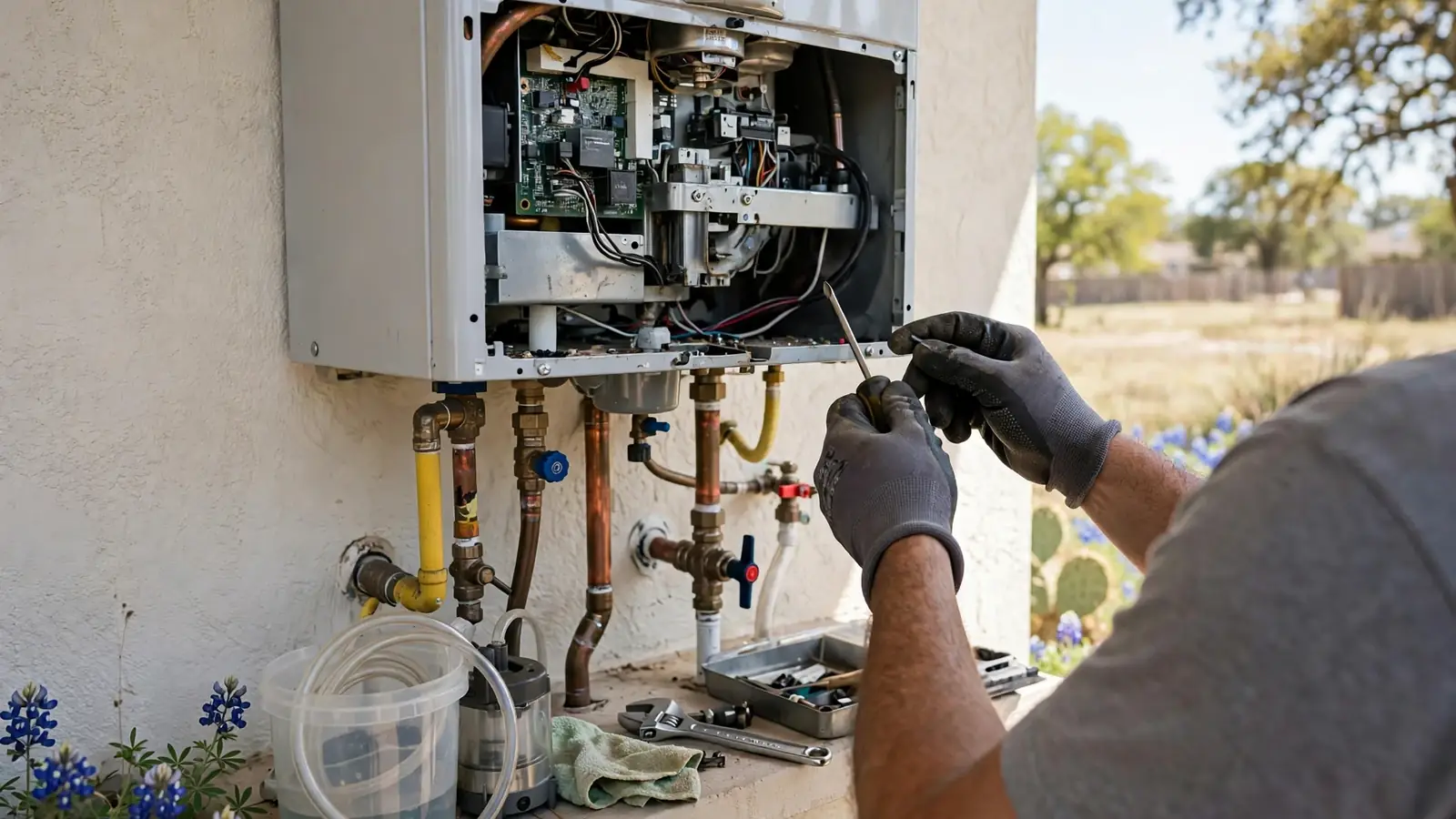
How a tankless heater differs from a tank
A tank heater stores 40 to 75 gallons and keeps it hot all day. A tankless unit fires a burner or electric elements the moment flow starts, and delivers a steady temperature until the flow stops. The limit is flow rate: if three showers and a dishwasher run at once, the unit may not keep up and the temperature drops.
| Factor | Gas tankless | Electric tankless |
|---|---|---|
| Output | High, handles several fixtures | Lower, often needs a large breaker |
| Requirements | Larger gas line and stainless vent | Heavy electrical service and wiring |
| Best fit | Whole-house use | Point-of-use or small homes |
| Upkeep | Annual flush, burner check | Annual flush, element check |
Installation requirements
The first check is the gas line. Most tankless units draw more gas than a tank heater, and an undersized line starves the unit and triggers error codes. Vent material and termination are specified by the manufacturer, and condensing models need a drain and a neutralizer for the acidic condensate.
Installers also add isolation valves so the unit can be flushed without disconnecting pipes. That feature is cheap during installation and expensive to add later, which is why we include it.
Flush and descale: the service people skip
Mineral scale builds on the heat exchanger, restricts flow and makes the unit work harder. Flushing circulates a mild acidic solution through the exchanger for a set time, then clears it with fresh water. Skipping it is the most common reason a tankless unit throws error codes, produces lukewarm water or fails early.
Most manufacturers call for an annual flush, and the interval can be shorter in hard water. A flush takes under two hours when valves are in place.
Repair: error codes and common failures
Flame failure, ignition errors, flow sensor faults and ventilation alarms account for most tankless service calls. A technician reads the code, checks gas pressure, cleans the burner and flame rod, tests the flow sensor and inspects the vent. A heat exchanger that has cracked from scale is a replacement item and may justify a new unit.
Error code on the display or lukewarm water. Call and give us the model and what the screen says.
Call (303) 552-3896Recirculating pumps and the wait for hot water
A tankless heater does not remove the wait for hot water at distant fixtures, because the cold water already in the pipes has to run out first. A recirculating pump, or a built-in recirculation function, keeps hot water moving through the loop. See our installation page for the whole picture, and ask whether a pump suits your pipe layout.
Commerce City hardness and tankless care
South Adams County Water and Sanitation District reports its water at 7 grains per gallon of hardness after the Ennis Water Softening Facility came online in March 2021. That is moderate, but still enough to leave scale inside a heat exchanger over several years, and the district notes irrigation water is not softened, so never connect a tankless unit to an irrigation line.
Any house can carry loose mineral debris from years of earlier plumbing work, and that debris can reach a tankless unit's inlet screen. Checking the screen at the first flush after installation is a cheap way to catch it.
What shapes the price
- Unit and brand
- Output, efficiency rating and warranty vary by model.
- Gas line and vent
- A new larger gas line and stainless vent often cost more than the unit itself.
- Existing tank removal
- Removing the old tank and patching connections adds labor.
- Recirculation
- A pump and return line add parts and time.
- Service interval
- Annual flushing is a small recurring cost that prevents larger repairs.
Insurance note: a planned upgrade is not covered by most policies, but sudden leaks from the unit may be. Keep manufacturer registration and flush records, since warranty claims often require them.
Want your real number? Call (303) 552-3896 and the price will be explained before work starts.
What to do before work begins
What to do before servicing a tankless unit: turn off the gas and power, close the water valves and let the unit cool. If you smell gas, leave and call 911 and your gas utility from outside.
Sources and standards
Commerce City adopted the 2021 International Plumbing Code (IPC) with local amendments, and its Building Safety Division at 303-289-3790 answers permit questions. Under those amendments, relief valve discharge goes to a sanitary drain (section 504.6.1, with replacements exempt) and water heaters need a pan in many installs (section 504.7, with exemptions).
Common questions
Once a year is the common manufacturer recommendation. Homes with hardness above the local average, or a heater with heavy use, may need it more often.
It does not run out the way a tank does, but it can exceed its flow capacity. Several fixtures at once may drop the temperature, and a larger model or two units solves that.
Yes, with a compatible unit or an added pump. Some models have built-in recirculation, and others need a return line and a pump with a timer.
Softer water slows scale but does not eliminate it. Check the heat exchanger and inlet screen yearly and flush on the maker's schedule.
It usually means the burner did not light or lost flame. Causes include low gas pressure, a dirty flame rod, a blocked vent or scale.
It can be, especially in newer homes with accessible gas lines. See the related water heater replacement page if your tank has already failed.
A tankless heater lasts longer with the right install and a yearly flush. Call to plan the work or book a service visit.
Call (303) 552-3896