
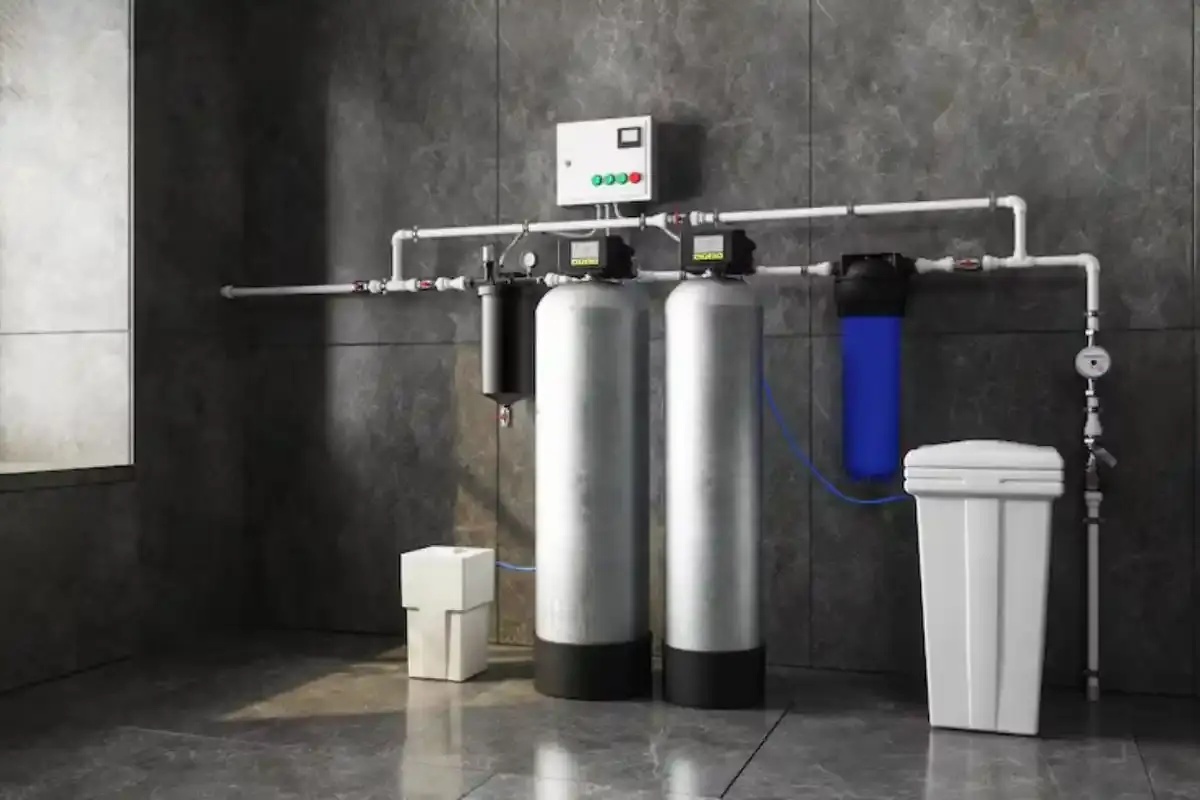
Why near the main
A softener treats all the water that passes through it, so it goes on the line after the main shutoff and before any branches. That way, every fixture that needs softened water gets it. It also goes before the water heater, so the heater receives softened water and avoids scale.
What it needs nearby
- A drain: a floor drain, a laundry standpipe or a utility sink with an air gap.
- A grounded 120 volt outlet for the controller.
- Floor space and a level base for the tank and the brine tank.
- Clearance to refill salt and to reach the bypass valve.
- Protection from freezing and from direct sun.
If one of these is missing, a plumber or electrician can add it, but it affects the cost, so check them before you buy.
Good locations by house type
| House type | Common location | Why it works |
|---|---|---|
| Basement | Near the main entry, by the water heater | Floor drain, space and stable temperature |
| Slab house with garage | Garage near the water entry | Space, drain and access |
| Utility closet or laundry room | Next to the water heater | Standpipe drain, outlet nearby |
| Crawlspace entry | Rarely, because of space and freezing | Consider an outdoor enclosure instead |
Outdoor spigots and irrigation
Most homes split the line so that hose bibs and irrigation stay on unsoftened water. Softened water on a lawn wastes salt and the water has no benefit there. The plumber installs the softener downstream of the branch that serves outdoor taps, or adds a bypass to those taps.
Locations to avoid
Avoid unheated spaces where the tank can freeze, areas that get direct sun, places with no drain nearby and spots behind a wall where servicing would be hard. Also avoid a location where the softener is downstream of the water heater, since the heater would then receive hard water.
The bypass valve
A bypass valve lets you isolate the softener for service or send unsoftened water to the house. It should be easy to reach, and many units have a built-in bypass. A three-valve bypass loop made with ball valves is a good choice if the unit does not have one.
Layout choices that make service easier
Pick a spot with room to open the lid and add salt without climbing over other equipment. Keep the unit off a floor that stays damp, and leave space for a drain line that slopes properly or a standpipe at the right height.
The bypass valve should be reachable without moving the tank. If the system will sit in a garage, think about freezing nights, because a cracked valve body is an expensive lesson.
Matching the location to your plumbing
The softener goes after the main shutoff and any whole house filter, and before the water heater, so all hot and cold fixtures get treated water. Exterior hose bibs should branch off before the softener if you want untreated water for the yard.
Homes with a basement often use a mechanical room, while slab homes may place the unit in the garage or a utility closet. A plumber can trace the main line to find the best tie in point.
Noise, salt storage and drain etiquette
A softener regenerates with a burst of water to the drain, usually in the middle of the night, so avoid placing it against a bedroom wall. Store salt bags on a pallet or shelf rather than on bare concrete, and keep them dry. Give the brine tank a clear path so you can check the salt level once a month.
Commerce City notes
The South Adams County Water and Sanitation District says the water it supplies is treated to 7 grains per gallon of hardness, and that irrigation water is not softened. Many Commerce City homes have a separate irrigation supply, so a softener should be placed on the potable line only.
Commerce City's list of permit items includes chemical dispensers connected to a water supply and new plumbing fixtures, and the city says the list is not exhaustive. Ask the Building Safety Division at 303-289-3790 how the rules apply to a softener, especially if you move a water heater or add a drain.
Choosing the final spot
Walk the house with a plumber and trace where the water enters. The best location is often a few feet from that point, in a space that has a drain and an outlet. Our water softener and filtration page explains the options, and water heater installation is useful when you plan both together. We serve Brighton, where the utility and the hardness may differ.
Sources and standards
Commerce City adopted the 2021 International Plumbing Code (IPC) with local amendments, and its Building Safety Division at 303-289-3790 answers permit questions. For water quality questions, the South Adams County Water and Sanitation District lists 303-287-6454 as its water quality line.
Common questions
Before. The heater should receive softened water to reduce scale.
In some cases, with an insulated enclosure and freeze protection. Indoors is usually better in this climate.
Usually not. The district's irrigation water is not softened, and softening outdoor water wastes salt.
A plumber can run a drain line or use a condensate pump. The cost depends on the distance.
It depends on the work. Call the Building Safety Division at 303-289-3790 to confirm.
A good location makes the system work and keeps service simple. Call and describe your house. Our service area covers nearby towns.
Call (303) 552-3896