
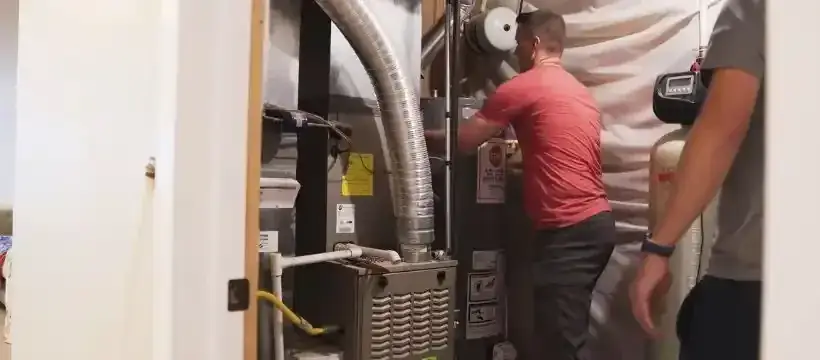
Start with the shutoff and drain
Before anything is disconnected, the cold water supply to the heater is shut off and the power or gas is turned off. A hose runs from the drain valve at the bottom of the tank to a floor drain or the outdoors, and a hot tap is opened somewhere upstairs so the tank can drain. Skipping the vent tap is the usual reason a tank drains slowly or glugs.
The cold and hot connections
The cold supply enters at the right side of the tank top, usually marked with a blue ring or the letter C. A full-port shutoff valve goes on the line so the heater can be isolated later. The hot outlet leaves from the other nipple and goes to the house hot line.
Flexible stainless connectors make the job easier, and dielectric fittings keep copper and the steel tank from corroding where they meet. Threads get thread sealant or tape, and the connections are hand tight plus a turn with a wrench, not cranked to the limit.
The relief valve and its pipe
The temperature and pressure relief valve is a safety device that opens if the tank gets too hot or too pressurized. It is threaded into the tank, and a discharge pipe runs from it downward to within a few inches of the floor or to a drain. The pipe must not be capped, reduced or threaded at the end, since a blocked relief valve is dangerous.
Expansion tank and pressure
When heated, water expands. In an open system, the extra volume pushes back into the street main. If the house has a check valve or a pressure reducing valve at the main, the system is closed and the water has nowhere to go, so pressure rises each time the heater fires.
A small expansion tank on the cold line absorbs that volume, and it needs its air charge set to the house pressure.
| Item | Purpose | Common mistake |
|---|---|---|
| Cold shutoff valve | Isolates the heater for service | Using a partial-flow valve |
| Dielectric or flex connectors | Protect against corrosion and vibration | Mixing metals with bare threads |
| Relief valve and discharge pipe | Prevents tank rupture | Capping or shortening the pipe |
| Expansion tank | Absorbs thermal expansion | Wrong air charge |
| Drain pan | Catches a leak | Omitting it where damage is possible |
| Gas shutoff, sediment trap, vent | Safe fuel supply and exhaust | Wrong vent pitch or size |
Gas heaters: line, trap and vent
A gas heater needs a rigid pipe or approved flexible connector from a shutoff valve to the gas control. A drip leg or sediment trap sits before the connection to catch debris.
The draft hood or vent connects to the flue with a continuous upward pitch and without sags, because a poor vent can push carbon monoxide into the house. Every gas joint is tested for leaks with a bubble solution, and this is one part of the job we strongly advise leaving to a licensed plumber.
Electric heaters: power and wiring
An electric heater needs a dedicated 240 volt circuit sized to the heater's rating, wire of the right gauge and a disconnect within sight where the code requires it. The power stays off until the tank is full, because running an element in an empty tank burns it out in seconds. Fill the tank, open a hot tap until water flows steadily and then restore power.
Filling, testing and setting the temperature
After connections are made, the cold valve is opened, a hot tap is left open until the air is gone and every joint is checked for drips. A gas heater is lit following the label, and the thermostat is set. Many homes use a setting near 120 degrees Fahrenheit to reduce scald risk and save energy, though some households choose a different point.
Commerce City code and permit notes
Commerce City has adopted the 2021 International Plumbing Code with 82 local amendments. According to the city's published amendments, a water heater must sit in a pan where a leak would cause damage, and relief valve discharge must be captured and conveyed to the sanitary drainage system. Replacements of existing water heaters are exempt from some of this, so the rules differ between a new installation and a swap.
The city's permit list includes new and replacement gas appliances and does not name water heaters directly. Call the Building Safety Division at 303-289-3790 or email cdpermits@c3gov.com to ask how it applies to your project, and check any plumber's license through the State Plumbing Board's Search for a Licensee tool.
When to call a plumber
A tank swap in an open garage is a manageable project for a skilled homeowner with the right tools. Gas piping, venting, relocation and anything involving a permit is best left to a licensed plumber. If you want a professional to handle it, see water heater installation, and if the old tank has already failed, water heater replacement covers replacement work for Commerce City and nearby Brighton.
Sources and standards
Commerce City adopted the 2021 International Plumbing Code (IPC) with local amendments, and its Building Safety Division at 303-289-3790 answers permit questions. Under those amendments, relief valve discharge goes to a sanitary drain (section 504.6.1, with replacements exempt) and water heaters need a pan in many installs (section 504.7, with exemptions).
Common questions
The city's amended code calls for a pan where a leak would cause damage, but it exempts replacements of water heaters that never had a code-compliant pan. Call the Building Safety Division at 303-289-3790 to confirm for your house.
Use materials rated for hot potable water, such as copper, PEX or CPVC, with proper fittings. Do not use garden hose or unrated flexible lines.
If the valve opens, the pipe carries hot water safely away. A capped or blocked pipe can make the valve useless, which is dangerous.
A like-for-like swap often takes a few hours. A fuel change or relocation takes longer.
It is a simple job, but the air charge must match your house pressure. Ask a plumber if you are unsure.
If you would rather not do the piping yourself, call the 24/7 line and a Commerce City plumber can plan the work. We cover the whole service area.
Call (303) 552-3896